McCurdy Group - Insurance and Financial Consultants

Wednesday, March 11, 2015

March Home Maintenance Tips

March Home Maintenance Tips

What do you need to do this month to keep your home running smoothly and your family protected?  Read below to find out! 

Change Batteries In Smoke Detectors - When the time changes, it’s a great idea to change the batteries in all smoke and carbon monoxide detectors.  This way you always know that they are working and in good order!  The spring time change this year is on Sunday March 8th. 

Make A Severe Weather Plan - Designate a safe place in your home in case of bad weather.  Stock it with basic emergency supplies and throw in an extra flashlight and batteries too!

Check Your Credit Report - March is Credit Education Month.  When was the last time you checked to see that your credit reports were accurate?  If it’s been over a year, stop by www.annualcreditreport.com and order a free copy today. 

Review Your Insurance Discounts - Are you getting all the discounts you qualify for?  Call us to review your policy and see if there are any changes that need to be made.


And as always, give us a call if you have any questions or need assistance with auto, home, business, or life insurance.  

Thursday, March 5, 2015

Do you have ice dams?

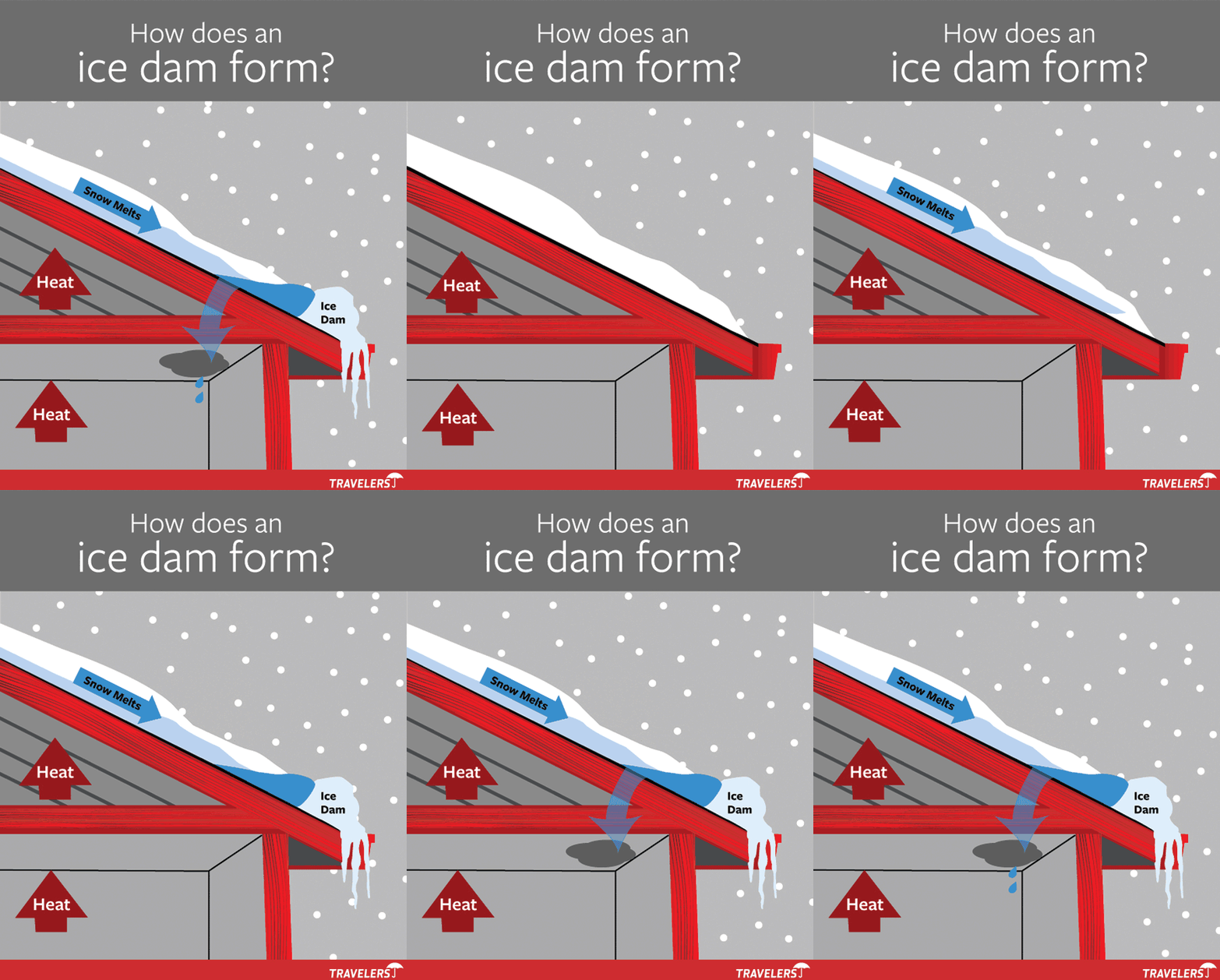
You can help prevent serious damage to both the roof and inside of your home by minimizing the likelihood that an ice dam will develop, and by removing one as soon as you spot it. Ice dams can form when water from melting snow re-freezes at the edge of your roofline. Without roof snow removal, an ice dam may grow large enough to prevent water from draining off the roof. This water can then back up underneath roof shingles and make its way into your home. 


How Do You Know if You Have an Ice Dam?

  • Look carefully at the icicles around the exterior of your house. If they are confined to the gutters and there is no water trapped behind them, then an ice dam has likely not formed. Nonetheless, icicles can pose a danger to people when they fall off, so try to safely knock them down while standing on the ground, making sure not to stand directly beneath them. If you cannot safely reach them from the ground, consider hiring a contractor to help.
  • Check for water stains or moisture in the attic or around the tops of exterior walls on the top floor of your house. Stains and moisture may indicate that an ice dam has formed and water has penetrated the roof membrane.
  

How to Remove an Ice Dam:

  • Melt the ice dam. Fill a nylon stocking with calcium chloride ice melt, and place it vertically across the ice dam so that it melts a channel through the dam. If you try this, make sure you can safely position the ice melt on your roof, and make sure to use calcium chloride, not rock salt. Rock salt will damage your roof. Also, be aware that shrubbery and plants near the gutters or downspouts may be damaged.
  • Get professional help. If you cannot safely reach the roof, avoid using a ladder in snowy and icy conditions. Consider hiring a contractor to remove the ice dam.

I you need the help of a contractor, we recommend Mike Dhembe, he can be reached at http://www.mdhembeschimneysweep.com/ and 508-765-9600.  

If you have any questions or concerns, please give us a call. 

Thursday, January 29, 2015

Winter Home Maintenance Tips

Travelers Insurance made a wonderful 'winter home maintenance tips' article. It is below. Have a safe and happy winter! 
As winter nears, make sure your home is prepared to withstand another season of cold temperatures, driving winds and icy conditions. The maintenance that you do today can help prevent more costly emergency repairs in the height of a storm, when it can be difficult to find supplies and licensed contractors.
Following are five important categories to focus on for this winter:

Your Heating System

Before you give your heating system a workout this winter, take the time for preventive maintenance. It may help extend the life of your system and identify potential problems.
Before winter:
  • Have your furnace or boiler checked and serviced by a licensed contractor at least once a year, preferably before the heating season begins.
  • Clean or replace the furnace filter on forced hot air systems.
  • Have your chimney checked and serviced by a licensed contractor at least once a year. Pay particular attention to having creosote build-up removed for chimneys servicing woodstoves and fireplaces.
     
During winter:
  • Have your fuel tanks filled and keep an eye on levels throughout the winter.
  • Set your heat no lower than 55 degrees as the temperature inside the walls where water piping is located is colder than the living spaces; open doors to unoccupied rooms to keep an even temperature throughout the house.
  • Maintain your wood-burning or pellet stoves according to the manufacturer's instructions.

 
Your Insulation

Is your insulation prepared to protect you from the cold? As an important line of defense from winter’s gusty winds and freezing temperatures, it is worth taking some time to inspect and upgrade insulation and weather stripping before the season starts.
  • Add extra insulation in the attic to guard against ice dams. If too much heat escapes into the attic, it can warm the ice and snow on the roof. When it refreezes, it can cause an ice dam, which can lead to water damage inside your home or possibly even a roof collapse.
  • Add weather stripping around doors and caulk windows to guard against drafts and heat loss.
  • Remove screens from windows, and install storm windows.

 
Your Utilities

Freezing temperatures can be especially damaging to your home’s water piping. Make sure your pipes are adequately prepared to withstand a cold snap and remember to take extra precautions if you are going to be leaving your home, including shutting off your water. 
  • Check for water leaks and fix problems immediately; wrap water piping in UL-Listed heat tape and insulate if it is exposed in unheated areas such as garages, crawl spaces or attics. Use only thermostatically controlled heat tape if your water piping is plastic and follow the manufacturer's installation instructions.
  • Learn how to shut off your water and know where your pipes are located in case they do freeze; you may be able to prevent water damage.

 
Your Winter Safety Measures

As you prepare for winter, following are some further safety measures that are especially important during the cold season.
  • Trim trees and remove dead branches so they do not damage your home or injure someone if they fall because of ice, snow or wind.
  • Keep gutters clear of leaves, sticks and other debris to ensure melting snow can drain properly. Make sure downspouts direct water away from the foundation.
  • Repair steps and handrails to make them safer in the ice and snow.
  • Check smoke detectors, fire alarms and carbon monoxide detectors and replace batteries to ensure they are operating properly.

  
Your Key Supplies and Equipment

The first storm of the year can come sooner than you think. Stock up early and get key equipment, like snow blowers and generators, in good working condition long before you need them, so you can be prepared to enjoy what the season has to offer.
  • Make sure you have snow shovels and a roof rake on hand. Stock your ice melting compound to melt ice on walkways.
  • Have your snow blower and generator serviced and any necessary repairs made.
  • Keep fuel for snow blowers and generators in approved safety containers and away from heat or flame producing devices. Do not store fuel in your basement.

Wednesday, December 17, 2014

Out with the old, in with the new!

When was the last time you looked closely at your oil tank?

Does it look more like this?                                                            


Or like this?


The McCurdy Group has recently upgraded our oil tank, and we would like to encourage you to consider doing the same. Did you know that when fuel oils leaks, it has the potential to ruin concrete floors, wood support beams, and even beneath floors and walls. If the area is saturated with fuel oil, demolition and removal can be your only option. And if the fuel oil leaves the house though cracks in the floors, drain tile systems, or sump pump, an environmental investigation may be necessary to check for soil and ground water pollution. The fuel oil can also cause damage to anything that is being stored near the tank.

If your tank look's questionable, you can call River Air HVAC at 774-230-6880. They did a wonderful job replacing our tank, and will be able to help you too.
If you are worried about a leak in your fuel tank these damages may be covered under your homeowners policy or the coverage may be available for purchase, you should contact your insurance agent.

Friday, December 12, 2014

Cyberbullying: More Than Words Can Hurt You

"Sticks and stones may break my bones but words can never hurt me."

We tell our children this so they won't react to other kids calling them names. The truth is that words can hurt, not physically, but emotionally and psychologically. Nowadays schoolyard bullying doesn't stop at school. With texting, cell phones, uploaded videos, and other social media these ever-more vicious attacks can be almost non-stop. Some of these cyberbullies even create websites specifically targeting a single victim.

Teenagers are online in one form or another nearly around the clock. Thus a cyberbully can reach their target anytime and the attack can be viewed by a much larger group of the victim's peers and even go viral. Websites and videos can eventually be pulled down but the damage has already been done and easily reloaded. A more pernicious aspect is some cyberbullies use anonymous emails or fake screen names to try to hide their tracks so the source can't be identified. This emboldens the bullies even more as they don't fear retaliation or punishment. Sadly law-enforcement is reluctant to get involved unless an actual crime is committed or there is a threat of physical harm.

As horrible as the idea of your child being a victim of cyberbullying, imagine if your child was the bully or falsely accused of being the bully. Civil lawsuits usually follow, psychological counseling is often recommended for both the victim and abuser. Even if the accusation of cyberbullying turns out to be groundless reputations have been ruined.

Contact your insurance agent to see if you have liability coverage, that could help you if you get sued. It is important to talk to your children and employees to help avoid a stressful situation for your family or workplace. No one wants to go though this, so be sure to think before you post, tweet, or upload. Once it's on the internet, it's there forever.

Wednesday, November 26, 2014


Car-deer collisions are surprisingly more frequent than you might think. Nationally, about 1.5 million people are involved in deer collisions each year and more than a hundred people die as a result.

According to AAA, almost seventy percent of car-deer accidents occur during October through December when deer are most active, but this doesn’t mean that motorists can let down their defenses in other seasons. Historically, the majority of the car-deer accidents happen between 5:30 and 7:30 a.m. or between 5:30 and 8 p.m.—the hours that coincide with dawn and dusk as well as the times that most cars are on the road.

SAFETY TIPS:

·If you see one deer, slow down. Chances are there is another close behind. Be especially careful in heavily wooded areas, where deer are more prone to dart out in front of the car.

·Also, use your high beams whenever possible. It will give you a larger field of vision and you’ll have more time to react to animals in the road ahead. It might also help you spot deer at the side of the road before they run across the highway.

·The best defense is to be prepared. Wear your safety belts.

·Be extra alert on two lane roads near dawn and dusk. Be particularly alert near deer-warning signs.They are placed at known crossing areas.

Police departments say swerving to avoid a deer is sometimes more dangerous than hitting one. Severe collisions with trees or other cars—or rollover accidents—might result. If you swerve, or skid to a stop, there’s a chance the deer might panic and dart into the path of another vehicle, or back into the path of yours.

So what should you do if a crash with a deer is unavoidable? Brake firmly, keep both hands on the steering wheel, stay in your lane, and sound your horn. In the case of the ’Cuda driver, a firm foot on the brake pedal as soon as the deer was in sight might have given the animal that extra bit of time to get out of the way.

The jury is out on deer whistles, which claim to alert animals that a car is nearby. Some drivers swear by them, claiming they stop deer in their tracks. Others swear at them, asserting they do nothing but panic the deer into stampeding across the road. Then there are yet others who doubt they work at all, saying that the deer don’t hear the whistles until it’s too late.

In the event of a car-deer collision, you will find, as this client did, that such accidents are covered under the comprehensive portion of an automobile policy. Some insurance carriers claim up to one third of all comprehensive losses result from deer collisions.

In instances where you swerve and avoid the animal but end up colliding with something else, such as the ditch, the collision portion of your policy would also apply. Keep this in mind when you set your collision deductible.

And watch out for moose! They usually inflict five times the amount of damage to the vehicle than a deer does. In 1985, the winter in Alaska was particularly bad. By March 13th, 1985, there had been 165 train-killed moose, and on that night, a single moose on the tracks derailed a train, engine, and five coal cars.

Essential tips to avoiding deer car collisions

·Watch out at dawn and dusk

·High beams on when possible

·Slow down!

·Brake, don’t swerve

·Honk the horn

Friday, October 3, 2014

The Snowbird’s Guide to Winterizing Your Home

Before we know it will be that time of year to pack up and go south for the winter to escape the New England winter’s fury. Here are some tips to start thinking about before you leave for securing your home while you’re gone:

•Turn the heat down but keep it high enough so that you won’t end up with frozen pipes that could burst

•Set programmable timers for the lights and television so that it appears that you are still living in the home

•Lock all windows and doors, including the inside garage door to the house, and place steel bars in slider doors

•Give a trusted friend or neighbor a key and ask them to check the house periodically

•Arrange to have the snow cleared from your sidewalk and driveway

•Ask your neighbor to park in your driveway periodically

•Add motion-detecting security lights outside

•Make sure your gutters are cleaned to prevent ice damns damage while you’re gone