McCurdy Group - Insurance and Financial Consultants
Showing posts with label awareness. Show all posts

Tuesday, March 31, 2015

New Law on the use of Headlights!

The Legislature has passed a new law that would require drivers to turn on their headlights whenever they turn on their windshield wipers. 


The new law, M.G.L. c. 85, § 15 takes effect on April 7, 2015. Below is the wording of the new section of the law:

A vehicle, whether stationary or in motion, on a public way, shall have attached to it headlights and taillights which shall be turned on by the vehicle operator and so displayed as to be visible from the front and rear during the period of 1/2 hour after sunset to 1/2 hour before sunrise; provided, however, that such headlights and taillights shall be turned on by the vehicle operator at all other times when, due to insufficient light or unfavorable atmospheric conditions, visibility is reduced such that persons or vehicles on the roadway are not clearly discernible at a distance of 500 feet or when the vehicle’s windshield wipers are needed; provided further, that this section shall not apply to a vehicle which is designed to be propelled by hand; and provided further, that a vehicle carrying hay or straw for the purpose of transporting persons on a hayride shall display only electrically operated lights which shall be 2 flashing amber lights  to the front and 2 flashing red lights to the rear, each of which shall be at least 6 inches in diameter and mounted 6 feet from the ground.

As a result, the list of surcharge-able incidents has been amended by adding two new requirements effective April 7, 2015.

1. Motorists are now required to turn on headlights and taillights whenever the windshield wipers are on.

2. Motorists are also required to turn on headlights and taillights when visibility is reduced so that persons or vehicles are not visible at 500 feet due to insufficient light or unfavorable atmospheric conditions.

The requirement to turn on headlights and taillights 1/2 hour after sunset and 1/2 hour before sunrise has not changed.

Thursday, March 19, 2015

Protect Your Family During Severe Weather

Protect Your Family During Severe Weather

Did you know that March is Severe Weather Preparation Month? 

While it may still feel like winter outside, it won’t be long until spring arrives.  And with it comes spring storms!  Is your family prepared?

First things first, make sure you have designated a safe place to go to if the weather gets bad.  It could be a basement, closet, or room with no windows or outside walls.  Make sure this space is cleared out enough that you could easily get your family inside if needed.  (You don’t want to be clearing out the closet if there is a tornado!)

Next, put together a small emergency kit.  What would you need if the power was out?  Consider putting in flashlights, extra batteries, canned food, and plenty of water.  (Don’t forget supplies for your pets too!)

Keep emergency phone numbers in your cell phone contacts, including the phone number for your insurance company!  You could even save a note in your phone with your policy numbers too.


While we can’t prevent bad weather, it’s always great to be as prepared as possible.  Take care of your family first and know that we’ll be there to protect your belongings.  

Thursday, March 5, 2015

Do you have ice dams?

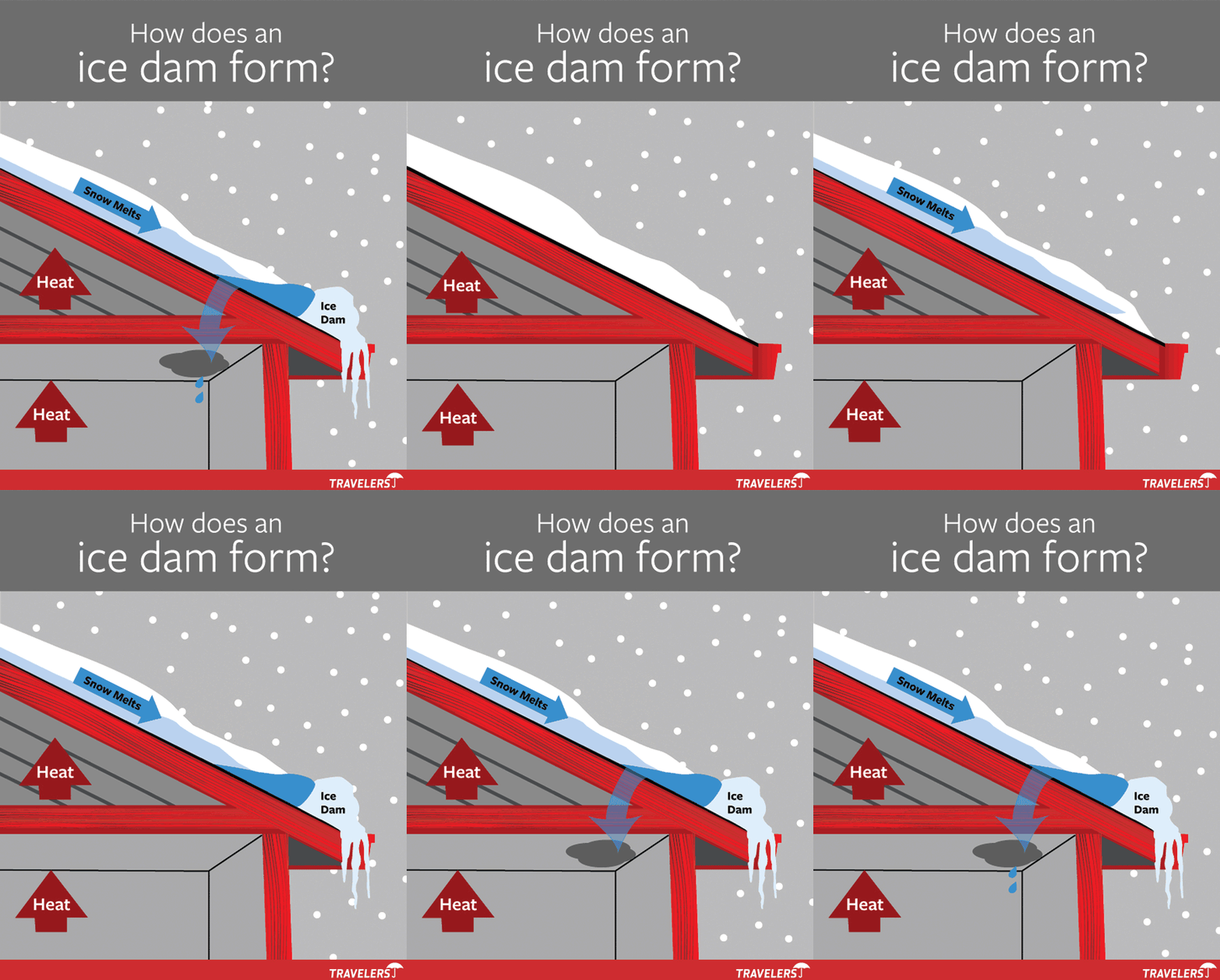
You can help prevent serious damage to both the roof and inside of your home by minimizing the likelihood that an ice dam will develop, and by removing one as soon as you spot it. Ice dams can form when water from melting snow re-freezes at the edge of your roofline. Without roof snow removal, an ice dam may grow large enough to prevent water from draining off the roof. This water can then back up underneath roof shingles and make its way into your home. 


How Do You Know if You Have an Ice Dam?

  • Look carefully at the icicles around the exterior of your house. If they are confined to the gutters and there is no water trapped behind them, then an ice dam has likely not formed. Nonetheless, icicles can pose a danger to people when they fall off, so try to safely knock them down while standing on the ground, making sure not to stand directly beneath them. If you cannot safely reach them from the ground, consider hiring a contractor to help.
  • Check for water stains or moisture in the attic or around the tops of exterior walls on the top floor of your house. Stains and moisture may indicate that an ice dam has formed and water has penetrated the roof membrane.
  

How to Remove an Ice Dam:

  • Melt the ice dam. Fill a nylon stocking with calcium chloride ice melt, and place it vertically across the ice dam so that it melts a channel through the dam. If you try this, make sure you can safely position the ice melt on your roof, and make sure to use calcium chloride, not rock salt. Rock salt will damage your roof. Also, be aware that shrubbery and plants near the gutters or downspouts may be damaged.
  • Get professional help. If you cannot safely reach the roof, avoid using a ladder in snowy and icy conditions. Consider hiring a contractor to remove the ice dam.

I you need the help of a contractor, we recommend Mike Dhembe, he can be reached at http://www.mdhembeschimneysweep.com/ and 508-765-9600.  

If you have any questions or concerns, please give us a call. 

Wednesday, July 30, 2014

Health Conditions That Are Dangerous for Driving

Before you get behind the wheel of your vehicle, you should always be aware of your physical and/or health condition. Driving has become so complicated because as drivers; we need to be aware of other dangers that may cause us to make a quick decision and react even quicker. You need to be at your best before you get behind the wheel to drive. You shouldn’t drive if:
• You have vision or hearing issues. Make sure that your eyes and ears have been checked. Also remember to wear sunglasses on sunny days.
• If you’ve been drinking alcohol. Your judgment and reaction time could be affected with the smallest amount of liquor that is consumed.
• If you’re taking medications, whether prescribed by your doctor or over-the-counter, that makes your drowsy.
• If you’re under the influence of any illegal drug.
• When you’re tired.
• When you are upset because anger and depression can cause you to drive carelessly.