McCurdy Group - Insurance and Financial Consultants
Showing posts with label water damage. Show all posts

Monday, August 31, 2020

Water Damage: A Renter's Potential Nightmare


According to the Insurance Information Institute (iii.org), water damage is the second most common cause of property damage. Yet, 63% of renters do not have renter’s insurance. Many tenants presume their landlord's insurance policy will cover the damage to their belongings. Unfortunately, this is not the case.


A landlord's insurance covers repairs to the building itself, not the renter's personal possessions. With winter’s chill upon us, if a pipe were to freeze and break thus flooding the apartment’s interior, the landlord would be responsible for repairing the pipe and any damage to the structure. As a tenant, you would be responsible for replacing your personal property.


Or let’s flip that around. Let’s say you caused the water damage due to an overflowing tub or sink causing water damage not only to your apartment, but to other units in the building as well. A renter’s policy can protect you from property damage to others.


Renters insurance covers your personal property in the event of a disaster. And it’s not expensive. The average policy, depending on coverage is about $20 per month for $20,000 policy, according to the Independent Insurance Agents and Brokers of America. 


What to do if you have a water loss:

  • Take photos and/or video of the damaged property. And don't throw anything away until your claims adjuster has completed an inspection. 

And if you don't have renter’s insurance, definitely call us now at 508-347-9343!


Monday, March 4, 2019

Water Damage: A Renter’s Potential Nightmare


According to the Insurance Information Institute (iii.org), water damage is the second most common cause of property damage. Yet, 63% of renters do not have renters insurance. Many tenants presume their landlord's insurance policy will cover the damage to their belongings. Unfortunately, this is not the case. 

A landlord's insurance covers repairs the building itself, not the renter's personal possessions. With winter’s chill upon us, if a pipe were to freeze and break thus flooding the apartment’s interior, the landlord would be responsible for repairing the pipe and any damage to the structure. As a tenant, you would be responsible for replacing your personal property.

Or let’s flip that around. Let’s say you caused the water damage due to an overflowing tub or sink causing water damage not only to your apartment, but to other units in the building as well. A renters policy can protect property damage to others. 

Renters insurance covers your personal property in the event of a disaster. And it’s not expensive. The average policy, depending on coverage is about $15 per month for $30,000 policy (Independent Insurance Agents and Brokers of America). A basic renters insurance policy covers:
  • Frozen pipe breaks
  • Windstorm or hail
  • The weight of sleet, snow or ice
  • Fire sprinkler failure
  • Plumbing leaks
  • An accidental discharge from an appliance

What to do if you have a water loss
  • Call your landlord and call us, your dedicated insurance representative at 508-347-9343
  • Take photos and/or video of the damaged property. And don't throw anything away until your claims adjuster has completed an inspection. 
And if you don't have renters insurance, definitely call us now!
McCurdy Insurance, 508-347-9343, where the Best Insurance is Prevention!

Monday, November 19, 2018

Water, Water Everywhere: Loss Data May Surprise You


Water damage is the leading cause of property-related losses for homeowners, according to Chubb claims data.

A recent Travelers report reveals similar findings: After analyzing eight years of claims data, the insurer found that 20% of homeowners claims were attributable to non-weather water issues including plumbing, sewer or appliance leaks and failures -- making non-weather water losses the second most common homeowners claim, after wind (24%). Meanwhile, 11% of homeowners claims were caused by weather-related water.

Beyond just contributing to claims frequency, water is also the culprit in many devastating losses. Travelers reports that non-weather water and weather-related water damage accounted for 17% and 7% of the most expensive homeowners claims in 2009-2016, respectively -- and since 2015, water losses exceeding $500,000 have doubled, while those exceeding $1 million have tripled, according to Chubb.

Despite all this evidence, however, consumers may not be taking water threats as seriously as they should. Regarding weather-related water losses, Chubb reports that nearly half of homeowners believe weather reporting is "regularly" or "frequently" exaggerated, and 36% believe it’s "sometimes" exaggerated.

Furthermore, between summer 2017 and 2018 -- a timeframe that encompassed one of the worst hurricane seasons on record -- Chubb reports that 64% of homeowners did not change their home protection strategies. But people are still at risk from hurricanes even if they don’t live near the coast: 33% and 31% of Chubb’s Hurricane Harvey and Irma claims, respectively, were 25-50 miles away from the shoreline. And hurricane or not, flood remains the No. 1 disaster in the U.S., says Ana Robic, COO, Chubb Personal Risk Services.

"A lot of people think, 'This is never going to happen to me -- this is only a problem in X location,'" says Tanya Brown-Giammanco, lead researcher on the Insurance Institute for Business & Home Safety’s Hurricane Harvey Wind Damage Investigation Report. "But most locations in the U.S. are prone to some kind of disaster."

Non-weather water can also be more devastating than many homeowners may realize. "Once a consumer has a water loss, they’re definitely more aware of it for the next time," says Angi Orbann, vice president of Product Personal Insurance at Travelers. "But other than that, consumers typically aren’t thinking about those type of water losses."

And if a homeowner is away and doesn't notice a leak immediately, "the damage can be quite severe," Orbann adds. "Think about a two-story home where there’s a bathroom on the second story. If that hose line goes, it’s easy for it to be running down to the downstairs and possibly the basement for eight hours or longer if you’re away for a weekend. Those claims tend to be very disruptive."

Robic outlines a real-life scenario in which a homeowner was away on vacation when their washing machine hose burst, causing water to run unmonitored for several days. The water caused significant damage to the first and second floors of the home, including substantial damage to a newly renovated kitchen on the first floor.

At McCurdy Insurance, we will talk with you about your most common and most expensive risks and advise you on how to prepare for or prevent some of those losses.
-->

Wednesday, August 24, 2016

September Home Maintenance Tasks


Every month, we share easy tasks you can do to keep your home in tip-top shape all year long.  So here are a few simple tasks you can do in September to prepare your home for cool fall weather!

Check Gutters -  Take a few minutes to make sure your gutters are clear.  With rain and falling leaves, gutters will be working overtime.  By making sure theyre clear now, youll avoid water damage later on. 

Clean The Dryer Vent - Lint accumulating in the dryer vent can cause a house fire.  A couple of times per year, unplug the dryer and thoroughly vacuum the area around the dryer vent and hose.  Remember to check the outside vent too! 

Gather Firewood - Will you be burning a wood stove or fireplace this winter?  Start gathering up firewood now and save yourself from the task when its cold outside. 

Get Ready For Autumn - Now is a great time to start planting some fall flowers.  Mums and pumpkins make a great addition to your front porch! 


Save On Home Insurance - Homeowners Insurance is an important part of protecting your belongings.  To make sure you have the best coverage, call us today for a free, no obligation quote.  

Thursday, March 5, 2015

Do you have ice dams?

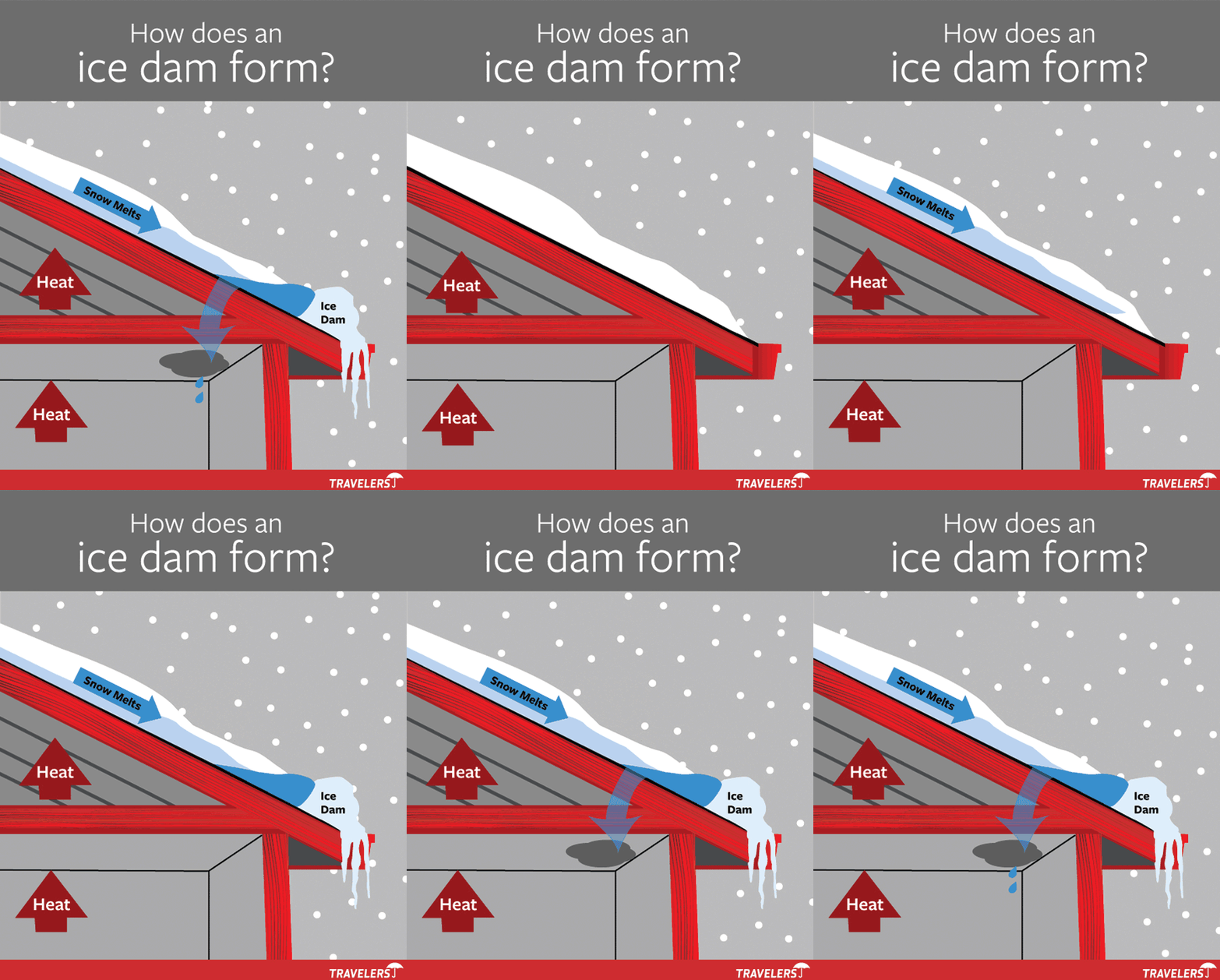
You can help prevent serious damage to both the roof and inside of your home by minimizing the likelihood that an ice dam will develop, and by removing one as soon as you spot it. Ice dams can form when water from melting snow re-freezes at the edge of your roofline. Without roof snow removal, an ice dam may grow large enough to prevent water from draining off the roof. This water can then back up underneath roof shingles and make its way into your home. 


How Do You Know if You Have an Ice Dam?

  • Look carefully at the icicles around the exterior of your house. If they are confined to the gutters and there is no water trapped behind them, then an ice dam has likely not formed. Nonetheless, icicles can pose a danger to people when they fall off, so try to safely knock them down while standing on the ground, making sure not to stand directly beneath them. If you cannot safely reach them from the ground, consider hiring a contractor to help.
  • Check for water stains or moisture in the attic or around the tops of exterior walls on the top floor of your house. Stains and moisture may indicate that an ice dam has formed and water has penetrated the roof membrane.
  

How to Remove an Ice Dam:

  • Melt the ice dam. Fill a nylon stocking with calcium chloride ice melt, and place it vertically across the ice dam so that it melts a channel through the dam. If you try this, make sure you can safely position the ice melt on your roof, and make sure to use calcium chloride, not rock salt. Rock salt will damage your roof. Also, be aware that shrubbery and plants near the gutters or downspouts may be damaged.
  • Get professional help. If you cannot safely reach the roof, avoid using a ladder in snowy and icy conditions. Consider hiring a contractor to remove the ice dam.

I you need the help of a contractor, we recommend Mike Dhembe, he can be reached at http://www.mdhembeschimneysweep.com/ and 508-765-9600.  

If you have any questions or concerns, please give us a call.