McCurdy Group - Insurance and Financial Consultants
Showing posts with label home improvement. Show all posts

Wednesday, May 13, 2015

The Biggest Risk To Your Home (And How To Prevent It)


Most people think the biggest risk to their home is a fire or a bad storm.  It’s why they buy insurance (and the fact it’s required by their mortgage lender). 

But in reality, the biggest concern is protecting your assets from a liability claim.  Consider this...

Warm weather has arrived and everyone is beginning their yard work. Mowing, planting
flowers, and digging those vegetable gardens. There is a lot of work to be done.

So let's say that you dig a large hole in the front yard so you can plant a new tree. You
walk away for a moment and while you're gone the kid next door runs through the yard,
falls in the hole, and breaks his ankle.

Unfortunately, you could be held responsible for his injury. But not to worry, your homeowner's liability insurance is made for these kind of situations. It will pay if someone is injured on your property. It's also the coverage that protects you if the dog bites your child's friend (as long as it's not a restricted breed) or if your cousin falls down your front steps.

If you have a large number of assets, then you'll want higher liability coverage. If the
injury exceeds your liability coverage amount, then you could be sued for the difference.
Work with us to determine the amount of coverage that you are comfortable
carrying.

No one can protect themselves by just being careful alone. There are too many
possible scenarios that you could never avoid. But with the right insurance coverage,
you'll never have to worry.

Call us today for a free review and to discuss how much liability coverage you need. 


Thursday, March 5, 2015

Do you have ice dams?

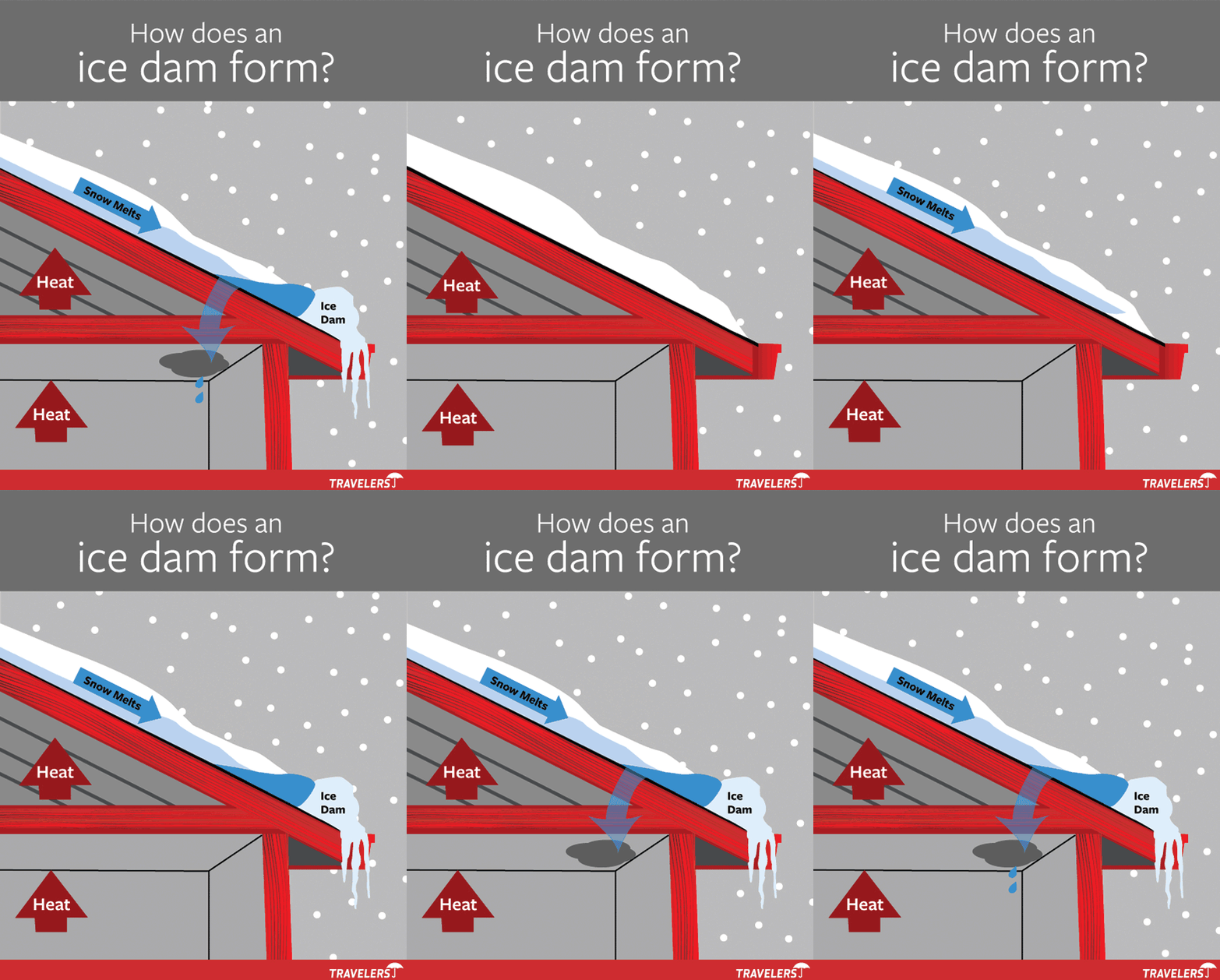
You can help prevent serious damage to both the roof and inside of your home by minimizing the likelihood that an ice dam will develop, and by removing one as soon as you spot it. Ice dams can form when water from melting snow re-freezes at the edge of your roofline. Without roof snow removal, an ice dam may grow large enough to prevent water from draining off the roof. This water can then back up underneath roof shingles and make its way into your home. 


How Do You Know if You Have an Ice Dam?

  • Look carefully at the icicles around the exterior of your house. If they are confined to the gutters and there is no water trapped behind them, then an ice dam has likely not formed. Nonetheless, icicles can pose a danger to people when they fall off, so try to safely knock them down while standing on the ground, making sure not to stand directly beneath them. If you cannot safely reach them from the ground, consider hiring a contractor to help.
  • Check for water stains or moisture in the attic or around the tops of exterior walls on the top floor of your house. Stains and moisture may indicate that an ice dam has formed and water has penetrated the roof membrane.
  

How to Remove an Ice Dam:

  • Melt the ice dam. Fill a nylon stocking with calcium chloride ice melt, and place it vertically across the ice dam so that it melts a channel through the dam. If you try this, make sure you can safely position the ice melt on your roof, and make sure to use calcium chloride, not rock salt. Rock salt will damage your roof. Also, be aware that shrubbery and plants near the gutters or downspouts may be damaged.
  • Get professional help. If you cannot safely reach the roof, avoid using a ladder in snowy and icy conditions. Consider hiring a contractor to remove the ice dam.

I you need the help of a contractor, we recommend Mike Dhembe, he can be reached at http://www.mdhembeschimneysweep.com/ and 508-765-9600.  

If you have any questions or concerns, please give us a call. 

Wednesday, December 17, 2014

Out with the old, in with the new!

When was the last time you looked closely at your oil tank?

Does it look more like this?                                                            


Or like this?


The McCurdy Group has recently upgraded our oil tank, and we would like to encourage you to consider doing the same. Did you know that when fuel oils leaks, it has the potential to ruin concrete floors, wood support beams, and even beneath floors and walls. If the area is saturated with fuel oil, demolition and removal can be your only option. And if the fuel oil leaves the house though cracks in the floors, drain tile systems, or sump pump, an environmental investigation may be necessary to check for soil and ground water pollution. The fuel oil can also cause damage to anything that is being stored near the tank.

If your tank look's questionable, you can call River Air HVAC at 774-230-6880. They did a wonderful job replacing our tank, and will be able to help you too.
If you are worried about a leak in your fuel tank these damages may be covered under your homeowners policy or the coverage may be available for purchase, you should contact your insurance agent.

Wednesday, April 30, 2014

Should I Contact My Agent If I’ve Made Changes to My Home?


Have you put an addition on your home or updated your kitchen or bath? Should make changes to your insurance policy? The answer is yes. A simple kitchen update from laminate counter tops to granite, installing new cabinets, or adding that jetted tub that you’ve always wanted could increase your home’s value considerably. If you’ve made any updates or added any square footage to your home, please contact your Insurance Agent to discuss whether or not you have adequate coverage to cover all the changes that you’ve made.

Wednesday, March 5, 2014

Speak to Your Insurance Agent about Home Improvements


Did you know that you may be able to save money on your homeowner’s insurance if you’ve updated your home? If you’ve updated your electric service, roof, or heating system, you may qualify for a more competitive rate. If you’re not sure if you qualify, contact your Insurance Agent to review your account.  Other improvements such as updating your kitchen or putting on an addition will probably increase the value of  your property and you should certainly discuss this with your agent to be sure your homeowner's policy has adequate limits.

It’s always good to review your personal account with your Insurance Agent from time to time to make sure that your home and auto policies are up to date and any questions can be discussed. Not only could your rate be affected, but you may discover that you don’t have coverage for something that you thought was all set.

Wednesday, January 15, 2014

Are Solar Panels Covered on a Homeowner's Policy


Many people now use solar panels and wonder if the panels are covered on their Homeowner’s Policies. The answer would be yes BUT.   We need to consider where the panels are installed in order to make sure that they have the appropriate coverage limits.  If they are installed on the house, they are considered part of the Dwelling limit but if they’re installed on the lawn and not connected to the home itself, they could be considered Other Structure or Personal Property Coverage depending on the company’s view. In any case, you need to make sure that you have enough coverage to handle a loss. There are also situations where the electric company pays you for supplying energy back to them; this would be considered a business and needs special attention. There are some carriers that offer the liability and physical coverage to protect this new “business” exposure. It’s best to discuss your needs with your Insurance Agent Professional to have the peace of mind that your interests will be covered.

Thursday, April 8, 2010

A Massachusetts Consumer Guide to Home Improvement

Every year, consumers spend millions of dollars on home improvements. Far too often, unsuspecting homeowners are cheated by home improvement contractors. In 1992, the Home Improvement Law was created to protect consumers and regulate the practices of home improvement contractors.

Remodeling and improving your come can be a huge undertaking. Fortunately, by understanding your rights under the law and taking a few precautions, you can help avoid potential problems. Be sure to plan carefully before investing thousands of dollars into home improvements.

  • Interview at least 3 contractors and request a written, detailed estimate.
  • Confirm references for each contractor. Check the contractor's complaint history with the Attorney General's Office or Better Business Bureau.
  • Always ask for a detailed written contract, even for small projects. It will protect you and help ensure that you and the contractor understand the scope of the job and the price. State law requires that home improvement contracts over $1,000 be in writing.
  • Be sure the contractor obtains the building permit.
  • By law, the contractor cannot collect more than one-third of the cost of the contract in advance.

For more details about the protections afforded to you through the 1992 Home Improvement Contractor Law, go to mass.gov/consumer/home improvement.